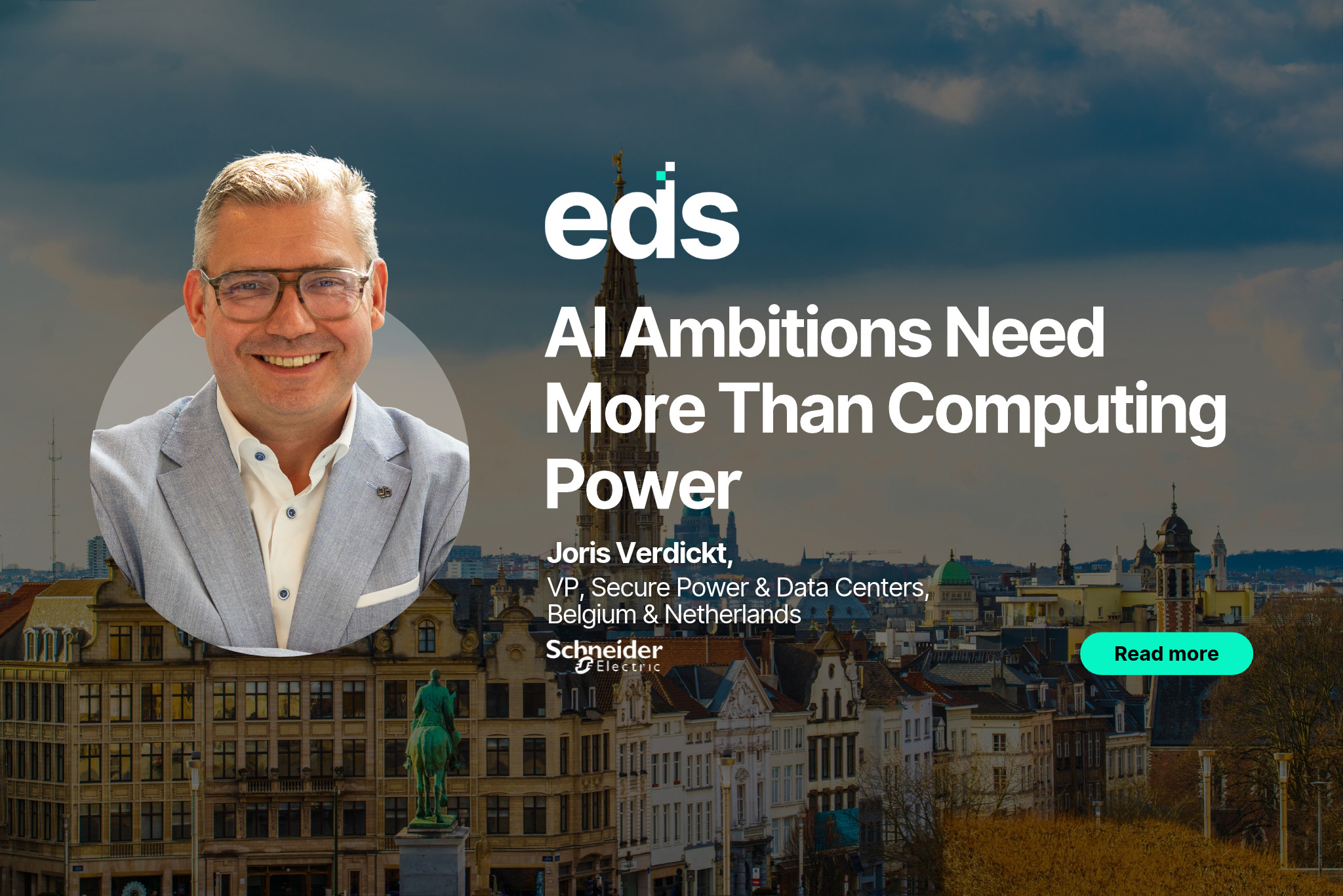
AI Ambitions Need More Than Computing Power
Isabelle Hudson
By Joris Verdickt VP, Secure Power & Data Centers, Belgium & Netherlands, Schneider Electric
AI has moved lightning-quick to executive priority. But as organizations accelerate, a fundamental question is emerging: can the infrastructure behind their ambitions keep up? For CIOs and CISOs, success will depend both on speed of adoption and on building a dependable foundation for the future.
Infrastructure: design for the full AI lifecycle
AI changes the equation for data centers and enterprise IT. Higher-density computing puts new pressure on power availability, cooling, capacity and operational continuity. The answer is not simply to add more hardware. It is to plan holistically: align workloads with the right environments, modernise power and cooling where needed, and use monitoring and digital tools to improve efficiency and anticipate constraints.
Cost and resilience must be designed in from day one. That means looking beyond initial capital expenditure to total cost of ownership, energy consumption, scalability and downtime risk. Modular, flexible infrastructure can help organisations grow without overbuilding today. I see an important role for Schneider Electric here: not only as technology provider, but also to act as a facilitator that connects the ecosystem and enables innovation. By designing together and planning ahead, we can accelerate projects, mitigate risks, and build infrastructure that can also handle future generations of AI.
Beyond the hype: AI is an operational challenge
One clear lesson from the market is that data quality, access rights, integration with legacy systems, governance and unpredictable costs can become serious obstacles. Moving from proof of concept to value at scale calls for clear use cases, realistic economics and shared accountability across IT, security, facilities and the business.
This has reinforced my belief in starting with the outcome, not the technology. Define what success looks like, understand the data and infrastructure requirements, and test resilience and security before scaling. AI readiness is as much an organisational discipline as a technical capability.
Digital sovereignty means informed choice
Meanwhile, across Europe, digital sovereignty is rightly becoming a boardroom discussion. Leaders need to understand where their data is processed, which critical services depend on external providers, and how easily they could adapt if commercial, regulatory or geopolitical conditions change. Sovereignty does not have to mean isolation or rejecting global technology partners. It means maintaining visibility, control and meaningful choices. We’re seeing a clear shift among our customers: the demand to keep data closer to home is growing. Especially in sectors and institutions with a lot of R&D, such as the pharmaceutical industry, we’re seeing strong demand for local infrastructure
A balanced approach combines trusted partnerships with open, interoperable architectures, sound data governance and resilient local or regional infrastructure where appropriate. Strengthening Europe’s digital competitiveness will require investment not only in AI applications, but also in the physical and energy infrastructure that makes them possible.
Innovation and security must advance together
My biggest takeaway in balancing innovation with security, resilience, and regulatory demands is that resilience cannot be added on after innovation. Cybersecurity, physical infrastructure, energy reliability, operational recovery and regulatory expectations are interconnected. An AI service is only as dependable as the systems that power, cool, connect and protect it.
This is where the CIO and CISO agendas converge. Both need a common view of critical dependencies, acceptable risk and business continuity. When security and resilience are considered at the design stage, they become enablers of innovation rather than obstacles to it.
At CIO & CISO Xseries Belgium, I look forward to discussing how we turn Europe’s AI ambitions into measurable, secure and sustainable progress. The real competitive advantage will belong to organizations that can innovate with confidence, and keep delivering when conditions change.
If you’re interested to learn more or take part, please RSVP below.